Why People Development is the foundation of Sustainable Change?
Organisations today are transforming at an unprecedented pace.
AI is reshaping industries. Leadership expectations are evolving. Teams are becoming more dynamic, cross-functional, and globally connected. Businesses are redesigning strategies to remain competitive in an environment where adaptability is no longer optional.
Yet despite significant investments in technology, restructuring, and operational change, many transformation initiatives fail to create long-term impact.
Not because the strategy lacked vision. But because the human side of transformation was underestimated.
Organisational transformation is often approached as a structural or technological shift. In reality, transformation succeeds when people are prepared to evolve alongside the business.
Processes can be redesigned quickly.
Systems can be upgraded rapidly. But sustainable transformation depends on whether people can adapt, collaborate, learn, and lead differently.
At Groval Selectia, organisational transformation is viewed as more than operational change. It is a process of developing leadership capability, strengthening culture, and enabling people to grow through change rather than merely respond to it.
Because organisations do not transform independently.
People do.
The Real Challenge behind Organisational Transformation
Most organisations focus heavily on visible transformation:
- New technology platforms
- Process redesign
- Structural realignment
- AI integration
- Performance acceleration
But transformation also creates invisible shifts within teams and leadership cultures.
Employees are expected to adapt to new expectations while simultaneously managing uncertainty, changing responsibilities, and increasing performance pressure. Over time, this creates emotional fatigue if organisations focus only on execution and not on people development.
The challenge is that transformation is not only operational.
It is emotional and behavioural.
When organisations overlook this reality, transformation often begins to lose momentum:
- Collaboration weakens
- Ownership reduces
- Innovation slows
- Communication becomes transactional
- Teams disengage emotionally
This is why sustainable transformation requires organisations to strengthen not only systems, but also human capability.
Why people development matters in transformation
Transformation requires new ways of thinking
The future workplace demands more than technical competence.
It requires people who can:
- adapt continuously,
- navigate ambiguity,
- collaborate across functions,
- communicate with emotional intelligence,
- and lead through complexity.
These capabilities cannot be developed through technology alone.
They emerge through intentional people development.
Organisations that invest in leadership coaching, reflective learning, and collaborative culture-building create employees who are better equipped to manage uncertainty and contribute meaningfully during periods of change.
The difference becomes visible over time.
| Operational Change | Human Development |
| New systems | New mindsets |
| Faster execution | Greater adaptability |
| Process efficiency | Emotional resilience |
| Structural redesign | Behavioural transformation |
| Performance pressure | Learning agility |
| Digital advancement | Human connection |
Transformation becomes sustainable when both sides evolve together.
Leadership shapes the emotional experience of change
The role of leaders during transformation
During organisational change, employees observe leadership behaviour more carefully than usual.
People notice:
- how leaders communicate under pressure,
- how they respond to uncertainty,
- whether they encourage learning,
- whether they remain approachable,
- and whether they create trust during difficult transitions.
This is why leadership development becomes central to organisational transformation.
Modern organisations no longer need leaders who only manage operations.
They need leaders who can develop people.
A transformational leader creates:
- psychological safety,
- growth-oriented conversations,
- collaborative culture,
- emotional trust,
- and a sense of shared purpose.
When leaders operate only through control and performance pressure, teams often become resistant or emotionally disconnected from change.
But when leaders focus on development, people become more willing to adapt and contribute.
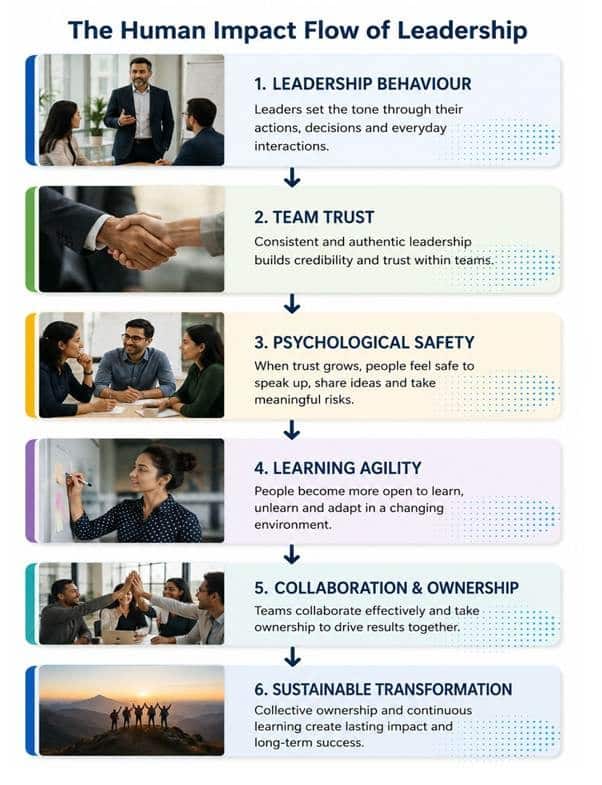
The quality of leadership ultimately shapes the quality of transformation.
Human development in the age of AI and digital transformation
As organisations accelerate AI adoption and digital transformation, conversations increasingly focus on automation, efficiency, and innovation.
However, technology transformation alone does not create organisational readiness.
Employees today are learning to work within rapidly changing environments while continuously adapting to new systems, workflows, and expectations. This requires more than technical training.
It requires emotional adaptability, learning agility, and leadership support.
AI can optimise processes.
Automation can improve efficiency.
Digital tools can accelerate decision-making.
But none of them independently create:
- trust,
- resilience,
- collaboration,
- empathy,
- or leadership maturity.
This is why human capability is becoming even more valuable in digitally evolving organisations.
Forward-thinking companies are recognising that future readiness depends on balancing technological advancement with people development.
They are investing in:
- leadership coaching,
- emotional intelligence,
- reflective leadership,
- collaborative learning cultures,
- and coaching-oriented management practices.
Because sustainable transformation happens when people grow alongside technology, not when technology replaces human development.
Creating a culture that supports transformation
From Compliance to Ownership
One of the biggest shifts organisations must make is moving from compliance-driven change to ownership-driven transformation.
People engage more meaningfully in transformation when they feel:
- involved in the journey,
- supported during uncertainty,
- trusted to contribute,
- and encouraged to learn continuously.
This requires organisations to build cultures where development becomes part of everyday leadership rather than a separate HR initiative.
Coaching-oriented organisations often create stronger transformation outcomes because they encourage:
- reflective conversations,
- open communication,
- continuous feedback,
- collaborative problem-solving,
- and growth-focused leadership.
These environments help employees move from passive adaptation to active participation.
Transformation stops feeling imposed.
It begins to feel shared.
Organisational transformation is ultimately about human growth
The most successful organisations understand that transformation is not only about improving business performance.
It is about expanding human capability within the organisation.
Because long-term business resilience depends on people who can:
- learn continuously,
- think adaptively,
- collaborate effectively,
- and lead consciously through change.
This is why sustainable transformation requires investment not only in systems and strategies, but also in human development.
The organisations that thrive in the future will not simply be those with advanced technology.
They will be the ones that create emotionally intelligent leadership cultures, adaptable teams, and environments where people feel capable of growing through change.
Because transformation becomes sustainable when people themselves begin to evolve.
Organisational transformation is often discussed in terms of strategy, systems, and performance. But the real strength of transformation lies in people.
Technology may accelerate change, but people determine whether change becomes meaningful and sustainable.
Businesses that invest in leadership development, coaching cultures, emotional intelligence, and collaborative growth create organisations that are not only future-ready, but also resilient, human-centered, and adaptable.
The future belongs to organisations that understand a simple but powerful truth:
Sustainable transformation happens when organisations develop people as intentionally as they develop strategy.
Partner with Groval Selectia to build Human-Centered Transformation
At Groval Selectia, we help organisations strengthen leadership capability, develop coaching cultures, and create transformation journeys that align business growth with human development.
Whether your organisation is navigating leadership transitions, cultural transformation, or future-readiness initiatives, our leadership coaching and organisational development solutions are designed to build sustainable impact.
Connect with Groval Selectia to create transformation that grows both people and performance.
FAQs
People development helps employees adapt to change, strengthen collaboration, improve emotional resilience, and build the leadership capabilities required for sustainable transformation.
Leadership shapes the emotional and cultural experience of change. Leaders who create trust, psychological safety, and growth-oriented environments often enable stronger transformation outcomes.
Human-centered transformation focuses on developing people alongside systems and processes. It prioritises leadership development, emotional intelligence, collaboration, and learning agility during change initiatives.
Organisations can prepare employees by combining digital skill development with coaching, reflective leadership, adaptability training, and collaborative learning cultures that help people grow confidently through change.
Coaching helps individuals and teams develop self-awareness, adaptability, communication, and ownership. Coaching-oriented cultures often create stronger engagement and long-term transformation success.