“The strength of a manager is not measured by how much they control. It is measured by how much they grow in others.”
There is a particular kind of manager that every Indian enterprise knows well.
Technically sharp. Deeply experienced. Committed to results. The person everyone turns to when a critical client needs attention, a complex problem needs solving, or an important decision needs to be made.
They carry institutional memory. They have earned credibility through years of contribution.
Yet managerial excellence in Indian enterprises is a different discipline altogether.
It requires the ability to create clarity where ambiguity exists, influence without relying on authority, balance business outcomes with people development, and build capability that extends beyond oneself.
So what does managerial excellence actually look like – not in theory, but in practice?
The context that makes India unique
Indian managers operate within a uniquely dynamic environment.
Hierarchy continues to influence workplace behaviour. Relationships often shape outcomes as much as systems do. Teams frequently bring together multiple generations with different expectations around communication, recognition, and leadership.
At the same time, businesses are evolving rapidly.
- Founder-led enterprises are professionalising.
- Mid-sized companies are expanding across geographies.
- Established organisations are navigating transformation while maintaining performance.
The modern Indian manager is expected to be strategic and operational, people-focused and performance-driven, decisive and collaborative—all at the same time.
This is not a challenge to overcome. It is the context in which managerial excellence is developed.
The shift from dependency to capability
At Groval Selectia, we often describe managerial excellence as the movement from dependency to capability.
In many organisations, work flows upward.
Decisions flow upward.
Problem-solving flows upward.
People become increasingly dependent on managers for direction and validation.
While this may create short-term efficiency, it limits long-term organisational growth.
Excellent managers reverse this flow.
They build capability outward and downward.
They strengthen judgment.
They expand ownership.
They develop confidence in decision-making.
Over time, teams become more capable, accountable, and self-sufficient.
This is one of the clearest signs of managerial excellence.
Not how much a manager does, but how much capability exists because of them.
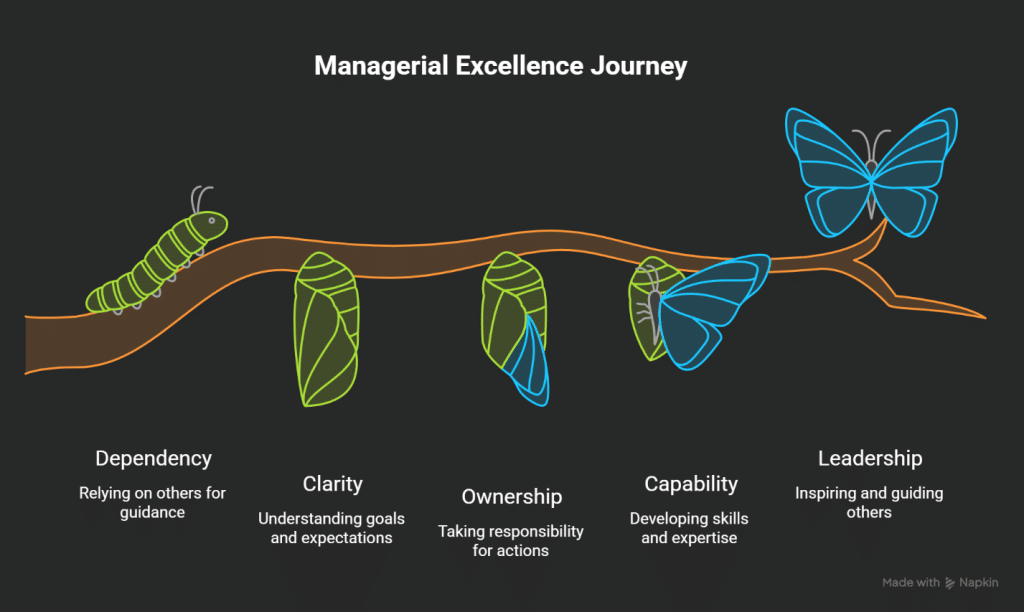
Managerial excellence is the journey from creating dependency on a manager to creating leadership capability across the organisation.
From Directing to Developing
One of the most visible markers of managerial excellence is the shift from directing to developing.
Many managers spend their time instructing, reviewing, and correcting.
Excellent managers spend increasing amounts of time helping people think.
They provide context, not just instructions.
They encourage ownership, not just compliance.
They create opportunities for people to exercise judgment rather than simply follow directions.
The outcome is powerful.
Teams become more confident.
Individuals become more capable.
And organisations become less dependent on a few key people.
As businesses grow, this shift becomes essential because sustainable growth requires capability at every level – not just expertise at the top.
Relationships and Directness, Together
Indian workplaces are deeply relationship-oriented. People are more likely to contribute their best when they feel respected, valued, and connected to their manager.
Excellent managers understand this.
They also understand that strong relationships become even more valuable when combined with professional clarity.
They care about people while maintaining standards.
They provide support while encouraging accountability.
They offer feedback in ways that build confidence and growth.
This combination is remarkably powerful.
Teams experience both trust and direction.
Commitment and performance grow together.
And the manager earns something more valuable than compliance—genuine respect.
A pattern we consistently observe
After working with managers across industries for more than two decades, one observation appears repeatedly.
The managers who build the strongest teams are rarely the most charismatic.
They are the most consistent.
Their expectations are clear.
Their standards are predictable.
Their feedback is timely.
Their behaviour aligns with what they ask of others.
Over time, that consistency creates trust.
And trust is what allows performance to scale.
People may admire brilliance.
But they grow under consistency.
Excellent managers create more leaders, not more followers
One of the most overlooked aspects of managerial excellence is the ability to create leadership in others.
The strongest managers are not the busiest people in the organisation.
They have learned how to create decision-making capability around them.
Instead of becoming the answer to every question, they help people develop the ability to answer questions themselves.
This distinction becomes increasingly important as organisations scale.
A manager who creates followers can grow a team.
A manager who creates leaders can strengthen an entire enterprise.
That is why leadership development begins long before formal leadership titles are earned.
It begins in everyday managerial conversations.
Managing different forms of potential
Every manager leads people with different strengths, aspirations, and developmental needs.
Excellent managers understand that people do not simply perform differently, they grow differently.
Some need stretch.
Some need structure.
Some need visibility.
Some need confidence.
The ability to recognise these differences and respond thoughtfully is one of the most valuable managerial capabilities in Indian enterprises today.
It transforms management from supervision into leadership.
Building managerial excellence as an organisational capability
Managerial excellence does not emerge by chance. It develops through experience, reflection, coaching, and intentional leadership development.
The organisations that consistently build strong managerial benches treat managerial development as a strategic business investment.
Not because they want better managers.
Because they want stronger execution.
Greater ownership.
More capable teams.
And sustainable growth.
When managerial excellence becomes part of organisational culture, performance becomes less dependent on individual heroics and more dependent on collective capability.
That is a far stronger foundation for long-term success.
Every organisation eventually becomes a reflection of its managers
Strategy may set direction.
Leadership may create momentum.
But managers determine how consistently excellence is experienced across the organisation.
The enterprises that sustain growth over time are those that intentionally develop managers who can strengthen capability, build ownership, and create future leaders.
As you think about the next stage of growth for your organisation, ask yourself:
- What kind of managers are shaping your culture today?
- What capabilities will your managers need tomorrow?
- How intentionally are those capabilities being developed?
If these questions are part of your leadership agenda, we would welcome the opportunity to exchange perspectives.
📩 Email: [email protected]
🌐 Website: https://grovalselectia.com/
Frequently Asked Questions
Managerial excellence refers to a manager’s ability to consistently create clarity, build ownership, develop people, and align team performance with organisational goals. In Indian enterprises, it also involves balancing relationships, accountability, and business outcomes in a dynamic and diverse work environment.
As organisations grow, sustainable success depends on the quality of managerial leadership. Excellent managers strengthen execution, build capable teams, improve collaboration, and ensure that organisational performance is not dependent on a few individuals alone.
Excellent managers demonstrate:
– Clear communication
– Ownership-driven leadership
– Strong people development skills
– Consistent feedback practices
– Strategic thinking
– The ability to build future leaders
Their focus extends beyond managing tasks to developing organisational capability.
Managerial excellence develops through structured learning, coaching, real-world application, reflection, and continuous feedback. Organisations that invest in managerial development programmes create stronger leadership pipelines and improve long-term business performance.
A manager focuses on coordinating work and achieving targets. An excellent manager creates capability within the team, develops independent thinking, strengthens ownership, and enables people to perform at higher levels consistently.