As technology becomes more powerful, human connection becomes more valuable.
Artificial intelligence is transforming industries. Automation is improving efficiency. Digital platforms are reshaping how organizations operate, communicate, and make decisions.
Yet amid these remarkable advancements, a new source of competitive advantage is emerging – ‘Human connection’.
For years, organizations have invested heavily in technology, systems, and operational excellence. While these investments remain essential, business success increasingly depends on something less tangible but equally powerful: the quality of relationships thatexist within teams, across leadership levels, and throughout the broader organizational ecosystem.
Human connection is no longer simply a cultural aspiration or a leadership ideal.
It is becoming a strategic business asset.
The new reality of organizational success
Modern organizations operate in environments defined by constant change, increasing complexity, and growing expectations from employees, customers, and stakeholders.
In such an environment, success is rarely determined by technology alone.
Projects move forward because people collaborate effectively.
Innovation emerges because individuals share ideas openly.
Customers remain loyal because they feel understood.
Change initiatives gain momentum because employees trust leadership.
At the heart of each of these outcomes is a human relationship.
Technology may accelerate processes and improve efficiency, but relationships influence how effectively people work together toward common goals.
Organizations that recognize this reality are beginning to view human connection as a critical business capability rather than a soft skill.
Human connection as organizational infrastructure
Organizations invest heavily in systems, processes, and technology to support performance. Equally important is the social infrastructure that connects people through trust, communication, and collaboration.
When this infrastructure is strong, teams share knowledge more effectively, decisions happen with greater confidence, and collaboration becomes easier. During periods of change, strong relationships help maintain alignment and engagement.
Organizations that intentionally strengthen these human connections create cultures that are more agile, resilient, and capable of sustained performance.
Relationship Capital: An emerging source of advantage
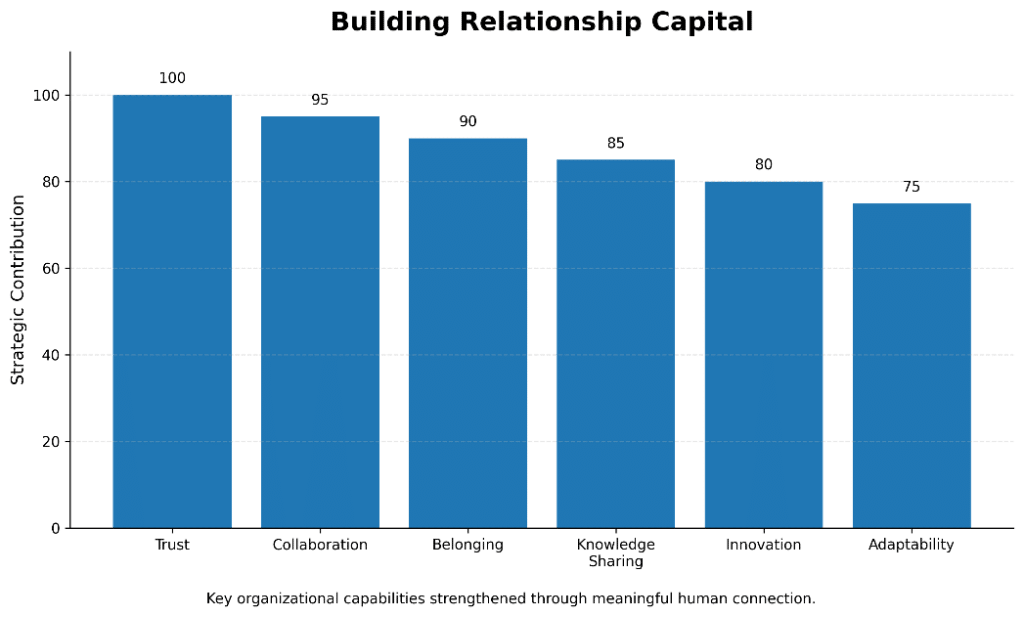
Key organisational capabilities strengthened through meaningful connection
Traditionally, organizations focused on building financial capital, intellectual capital, and operational capability.
Today, another form of value creation is gaining importance.
Relationship capital.
Relationship capital refers to the collective strength of trust, credibility, collaboration, and meaningful connections that exist within an organization and across its stakeholder ecosystem.
It influences:
- Employee engagement
- Team effectiveness
- Leadership credibility
- Customer loyalty
- Knowledge sharing
- Organizational adaptability
Unlike technology or physical assets, relationship capital cannot be purchased.
It develops gradually through consistent leadership behaviour, shared experiences, mutual respect, and authentic interaction.
Organizations with strong relationship capital often navigate uncertainty more effectively because people are willing to support one another and work together toward common outcomes.
Leadership is becoming increasingly relational
Leadership expectations continue to evolve.
While expertise and strategic thinking remain important, leadership effectiveness is increasingly linked to the ability to build trust and strengthen relationships.
People look to leaders not only for direction but also for connection.
The most influential leaders are often those who:
- Listen attentively
- Communicate with authenticity
- Encourage participation
- Respect diverse perspectives
- Build trust through consistency
- Create environments where people can thrive
These leaders understand that performance improves when people feel valued, respected, and connected to a meaningful purpose.
Leadership is therefore becoming less about authority and more about influence, engagement, and human understanding.
Organizations that develop relationally intelligent leaders are better positioned to sustain performance in complex environments.
Why belonging matters more than ever?
People want to feel that they are part of something meaningful.
Belonging creates a sense of connection between individuals, teams, and organizational purpose.
When employees feel included and valued, they are more likely to contribute ideas, collaborate openly, and remain committed to shared objectives.
Belonging supports:
- Motivation
- Collaboration
- Learning
- Creativity
- Commitment
- Long-term engagement
Organizations that foster belonging create environments where individuals can contribute their strengths with confidence.
This not only improves workplace experience but also strengthens overall organizational performance.
Innovation begins with conversations
Innovation is often associated with breakthrough technologies and disruptive ideas.
However, innovation begins much earlier. It begins with conversations.
New ideas emerge when people exchange perspectives, challenge assumptions, and explore possibilities together.
Organizations that consistently innovate create environments where individuals feel comfortable speaking up, sharing insights, and contributing diverse viewpoints.
Such environments are characterized by:
- Open dialogue
- Mutual respect
- Curiosity
- Collaboration
- Psychological safety
Technology can support innovation, but meaningful innovation remains deeply dependent on human interaction.
The quality of relationships often shapes the quality of ideas.
Strengthening organizations for a changing world
Organizations today must continuously adapt to evolving technologies, workforce expectations, and market realities.
Adaptability, however, is not created by strategy alone. It depends on people working together with trust, openness, and shared purpose.
Strong relationships help teams navigate uncertainty, embrace new directions, and collaborate more effectively during transitions. In an increasingly dynamic business environment, human connection remains one of the strongest enablers of organizational resilience.
The advantage that technology cannot replicate
Technology can be acquired.
Processes can be optimized.
Products can be copied.
Human connection is different. It develops through trust, credibility, shared experiences, and meaningful leadership over time.
These qualities become embedded within culture and influence how organizations perform, innovate, and grow.
As businesses continue investing in digital transformation, many competitive advantages will become easier to replicate.
The strength of human relationships will remain far more difficult to duplicate.
Organizations that invest intentionally in connection are not simply building stronger cultures. They are creating a strategic advantage that supports sustainable growth, leadership effectiveness, innovation, and long-term success.
Because while technology may shape how organizations operate, human connection continues to shape how organizations flourish.
Ready to strengthen human-centered organizational excellence?
At Groval Selectia, we partner with leaders and organizations to strengthen leadership effectiveness, organizational culture, collaboration, coaching capability, and sustainable performance.
If your organization is seeking to build stronger relationships, foster greater alignment, and develop leadership that creates lasting impact, we would be delighted to begin a meaningful conversation.
Connect with Groval Selectia to explore leadership and organizational development solutions designed for long-term organizational growth and human flourishing.
Frequently Asked Questions
Relationship capital refers to the trust, credibility, and collaborative strength that exists within teams, organizations, and stakeholder networks.
Human connection strengthens collaboration, engagement, innovation, and organizational effectiveness.
Yes. Strong relationships often contribute to better teamwork, customer loyalty, adaptability, and sustainable growth.
Through active listening, empathy, authentic communication, and creating inclusive environments.
As technology automates more tasks, human capabilities such as trust-building, collaboration, and relationship management become increasingly valuable.